Insect Killer vs Insect Catcher: Which Is Better for Your Business?
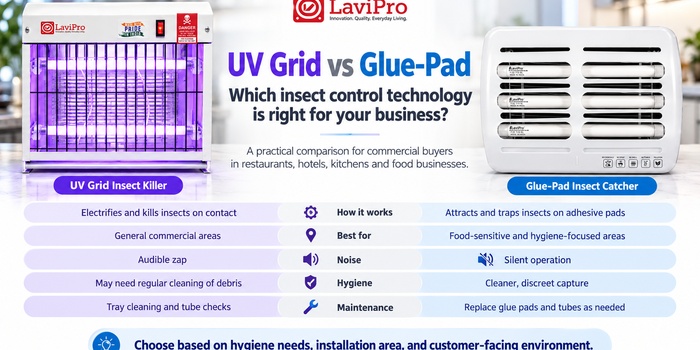
UV Grid Insect Killer vs Glue Pad Insect Catcher: Which Should Your Business Choose?
Managing flying insects is an important operational consideration for many commercial premises, including restaurants, bakeries, retail stores, warehouses, factories, offices and hospitality properties. However, selecting equipment is not simply a matter of choosing an electric unit. The right option depends on where the unit will be installed, how it will be maintained, how visible captured insects can be, and what routine your staff can realistically follow.
In an insect killer vs insect catcher comparison, the two common technologies are the UV grid insect killer and the glue pad insect catcher. Both may use light to attract certain flying insects, but they retain insects differently and involve different cleaning and servicing workflows.
This guide explains the practical differences so commercial buyers across India can compare options according to their premises and operating needs.
Choosing the Right Flying Insect Control Method
Commercial flying insect control is most effective when equipment selection is considered alongside placement, sanitation routines, waste handling, entry-point management and regular servicing. A single unit type is not automatically suitable for every room or business.
Before comparing models, consider the nature of the space. Is it a customer-facing reception area, a food-preparation zone, a loading bay, a warehouse aisle or a staff utility room? Does the area have open doors, strong airflow, bright ambient lighting, dust or frequent cleaning? These details influence the practical suitability of an insect control unit.
What Is a UV Grid Insect Killer?
A UV grid insect killer is an electric insect control unit that uses ultraviolet light to attract certain flying insects. Depending on the design, insects approaching the light pass through or near an electrified internal grid. The grid controls the insects, which are then collected in a tray or another lower section of the unit where applicable.
These units are often referred to as electric fly killers. However, the precise construction, light source, collection arrangement and mounting method can vary by model. Buyers should review the product manual and specifications for the unit under consideration rather than assuming all grid units work in exactly the same way.
How UV Grid Units Attract and Control Flying Insects
The UV light acts as an attractant for certain species of flying insects. Once an insect reaches the grid area, the electrified grid is designed to control it. In many designs, insect residue falls into a removable collection tray.
Because this approach involves an electric grid, the unit should be installed, used and serviced according to the manufacturer’s instructions. Electrical access, mounting stability and safe access for cleaning are important considerations.
Typical Maintenance Requirements
Electric insect killer maintenance generally includes cleaning the collection tray, removing insect residue, inspecting the grid area and checking the overall condition of the unit. UV lamps, tubes or other serviceable components may require replacement at intervals stated by the manufacturer.
Maintenance frequency depends on insect activity, dust levels, operating hours and the installation location. A unit installed near a busy entry point may require more frequent attention than one in a low-traffic enclosed area.
What Is a Glue Pad Insect Catcher?
A glue pad insect catcher also typically uses light to attract certain flying insects, but it retains them on an adhesive glue board or pad rather than using an electrified grid. Insects that enter or approach the unit are caught on the adhesive surface, depending on the product design.
The glue board is a replaceable consumable. When it becomes full, dusty, less adhesive or due for scheduled replacement, staff remove the used board and fit a new one according to the unit’s instructions.
How Glue Pads Capture Flying Insects
In a glue pad insect catcher, the adhesive board is positioned inside or behind the unit’s attraction area. The board holds captured insects in place. This gives maintenance staff a visible record of what has been captured, which may be useful when monitoring insect activity in particular areas.
The visibility of the board varies by unit design and installation position. Some businesses may prefer a more discreet placement in customer-facing areas, while others may prioritise easy access for monitoring and replacement.
Pad Replacement and Routine Servicing
Glue board insect catcher replacement frequency is not fixed. It can be affected by insect load, dust, grease, humidity, placement, operating conditions and the manufacturer’s maintenance guidance. A board may need replacement because it is full, contaminated with dust or no longer suitable for effective use.
Routine servicing may include checking the board, safely removing and disposing of the used pad, cleaning accessible areas of the unit, and inspecting lamps or other replaceable components where relevant. Staff should follow the supplier’s instructions for handling and disposal.
Insect Killer vs Insect Catcher: Key Differences
The following electric fly killer comparison highlights the practical differences between the two approaches. Actual features vary by model, so use this as a selection framework rather than a substitute for product documentation.
| Comparison Point | UV Grid Insect Killer | Glue Pad Insect Catcher |
|---|---|---|
| Operating method | Uses UV light to attract certain insects and an electrified grid to control them. | Uses UV light or another attraction arrangement, depending on design, and an adhesive pad to retain insects. |
| How insects are retained | Usually collected in a removable tray or lower collection area. | Held on a replaceable adhesive glue board or pad. |
| Visibility of captured insects | Insects may be less visible when collected in a tray, depending on the design. | Captured insects remain visible on the glue board until it is replaced. |
| Maintenance process | Requires cleaning of the tray and grid area, plus periodic inspection. | Requires inspection and replacement of glue boards, along with routine cleaning. |
| Consumables | May require replacement lamps or other serviceable parts over time. | Requires replacement glue boards or pads and may also require lamp replacement where applicable. |
| Staff handling | Staff need safe access for cleaning and servicing the electric unit. | Staff need a consistent procedure for checking, removing and replacing adhesive boards. |
| Placement considerations | Requires suitable electrical access, clearance and access for tray cleaning. | Requires access for viewing and changing the glue board without disrupting operations. |
| Operating-cost considerations | Includes electricity use, cleaning labour and replacement parts where required. | Includes electricity use where relevant, regular glue-board purchases, cleaning labour and replacement parts where required. |
Which Technology Suits Different Business Environments?
The suitable type of commercial fly control equipment depends on the area being protected, site procedures and how the unit can be maintained. The following examples are intended to guide assessment, not to set universal rules.
Food Service Areas, Restaurants and Cafés
For flying insect control for restaurants, placement and servicing discipline are especially important. Buyers should consider entry points, waste areas, dishwashing zones, food preparation practices, cleaning schedules and any internal hygiene procedures followed by the business.
A glue pad insect catcher may be considered where staff prefer adhesive capture and planned pad replacement. A UV grid insect killer may be considered in suitable areas where its cleaning and servicing routine can be properly followed. The unit should not be placed where it interferes with food handling, cleaning operations or site-specific procedures.
Retail Stores, Offices and Reception Areas
In customer-facing spaces, appearance, placement and the visibility of captured insects can influence the choice. A glue pad unit may suit businesses that want a contained adhesive-capture approach and straightforward board replacement. A grid unit may suit areas where its operating method and cleaning requirements are acceptable.
Evaluate the unit’s position carefully. It should be accessible to staff but not placed where it obstructs walkways, looks out of place or competes with strong surrounding lighting.
Warehouses, Manufacturing and Utility Areas
Insect control for warehouses and factories often involves practical constraints such as dust, high ceilings, loading activity, vehicle movement, open shutters and limited access for servicing. The equipment should be positioned where staff can inspect and maintain it safely.
For these sites, compare the available mounting space, electrical access, dust exposure, expected insect activity and the time available for routine checks. A unit that is difficult to reach is less likely to receive consistent maintenance.
Hotels, Healthcare and Customer-Facing Premises
Discretion, documented maintenance and site-specific policies may carry greater weight in hotels, healthcare environments and other customer-facing premises. Buyers may consider how visible the unit and captured insects will be, who will perform servicing, and whether maintenance can be scheduled without disrupting guests, visitors or daily operations.
Internal procedures, facility requirements and the manufacturer’s installation guidance should guide the final selection and placement decision.
Buyer Checklist Before Selecting a Unit
Assess the Premises and Insect Activity
- Identify the rooms or zones where flying insects are noticed.
- Check nearby doors, windows, vents, waste-storage areas and delivery entrances.
- Consider airflow, ambient lighting, operating hours and seasonal changes.
- Note whether the location is customer-facing, food-related, dusty or high traffic.
- Decide whether one unit type is needed throughout the site or whether different areas need different approaches.
Review Installation and Service Access
- Confirm appropriate wall, ceiling or counter mounting options according to the unit design.
- Check electrical access and avoid reliance on unsuitable extension arrangements.
- Ensure there is enough clearance for cleaning, tray removal or glue-board replacement.
- Choose a location that staff can reach safely and consistently.
- Use the manufacturer’s insect killer placement guide and installation instructions for the specific model.
Compare Total Ownership Considerations
The purchase price is only one part of a commercial insect control buying guide. Compare the expected maintenance routine and the resources required over time. For grid units, consider cleaning time and replacement lamps or serviceable parts where applicable. For glue-pad units, include the ongoing need for replacement boards or pads.
Electricity use, cleaning labour, replacement-component availability and the number of units required for different areas can also affect overall operating cost. Ask suppliers for model-specific details rather than estimating from product type alone.
Check Documentation and Supplier Support
Before purchasing, review the product manual, installation guidance, warranty terms, replacement-part availability and maintenance instructions. If your site has internal compliance, hygiene or facility-management requirements, confirm that the selected equipment can be assessed against those requirements.
For commercial buyers, reliable access to suitable consumables and clear servicing instructions can be as important as the initial equipment choice.
UV Grid or Glue Pad: A Practical Decision Guide
A UV Grid Unit May Be Considered When...
- Your team is prepared to follow routine tray cleaning and grid-area inspection procedures.
- The proposed installation area offers safe electrical access and service access.
- A grid-based operating method fits the use of the particular area.
- You have reviewed the model’s maintenance instructions and replacement-part needs.
A Glue Pad Unit May Be Considered When...
- You prefer insects to be retained on an adhesive board for inspection and planned replacement.
- Staff can check and replace glue boards on a consistent schedule.
- You are evaluating visibility and discretion in a customer-facing or managed environment.
- You can maintain an appropriate supply of replacement pads for the selected model.
When a Site Assessment Is the Better Next Step
Larger facilities, multi-area businesses and specialised premises may need more than a basic product comparison. A site assessment can help identify entry points, activity zones, practical mounting locations, maintenance access and whether different areas need different equipment.
This is particularly useful where food operations, large loading areas, multiple floors, high insect activity or strict internal procedures affect the decision.
Frequently Asked Questions
What is the difference between an insect killer and an insect catcher?
An insect killer commonly refers to a UV grid insect killer that uses an electrified grid to control insects attracted to the unit. An insect catcher commonly refers to a glue pad insect catcher that retains insects on an adhesive board. Both terms can vary in marketplace usage, so check the operating method of the specific model.
Which system requires more maintenance?
Neither is universally more demanding. A UV grid unit requires cleaning of insect residue and inspection of the grid and collection area. A glue pad unit requires regular checks and replacement of adhesive boards. The actual workload depends on insect activity, dust, placement and the manufacturer’s servicing guidance.
Do UV grid units and glue pad units use different consumables?
Yes. Glue pad units use replaceable adhesive boards or pads. Grid units may require replacement lamps, tubes or other serviceable parts depending on the model. Some glue pad units may also use replaceable lamps.
How often should glue pads or lamps be replaced?
Follow the manufacturer’s guidance for the specific unit. Glue pads may need replacement sooner when insect activity, dust or contamination is high. Lamp replacement intervals also vary by product design and usage conditions.
How should a commercial insect control unit be positioned?
Positioning should account for insect activity, entry points, airflow, surrounding light, electrical access and servicing access. Avoid placing equipment where it obstructs work, creates a safety concern or conflicts with site procedures. Always use the manufacturer’s installation instructions for the selected model.
Is one technology always better than the other?
No. The better choice depends on the installation environment, preferred capture method, visibility requirements, staff maintenance capacity, consumables planning and the features of the individual model.
Conclusion
An insect killer vs insect catcher decision should be based on how the equipment will work in your actual premises, not only on the initial purchase cost. UV grid insect killers and glue pad insect catchers use different retention methods and require different maintenance routines. Both can be evaluated as part of a broader commercial flying insect control plan.
Before selecting a unit, assess the installation area, expected insect activity, access for servicing, consumable requirements and staff responsibilities. For food businesses, warehouses, retail spaces and other commercial sites, the most suitable approach may differ from one area to another.
If you are evaluating insect control equipment for Indian businesses, share your business type, installation area, operating conditions and maintenance preferences with LaviPro. Our team can help you review relevant product details, compare suitable models and consider a site-specific recommendation.
About
LaviPro Expert is a kitchen appliance expert with years of experience reviewing and testing products for LaviPro.